Island Hopping: A Spirited Tour of Caribbean Rum

If rum has a spiritual home, it is the Caribbean. This is where it was born, and where it was traded, taxed, rationed, smuggled and fought over for the best part of four centuries. Having already taken you to the French Antilles for some Rhum Agricole, and back home to the Rum Corps and Bundaberg in our history of Australian rum, it is about time we went to the source and did a bit of island hopping.
So grab your sunnies. Today we are looking at where Caribbean rum came from, who makes it, what it tastes like, and why a rum from Jamaica and one from Cuba can taste like they come from different planets, even though the two islands sit less than 150 km apart.
Sugar, Ships and a “Hot, Hellish and Terrible Liquor”
Sugarcane is not native to the Caribbean. Christopher Columbus brought cuttings over from the Canary Islands on his second voyage in 1493 and planted them on Hispaniola, the island that is today shared by Haiti and the Dominican Republic. The Spanish, however, were far more interested in gold than in farming, and it took the arrival of the English, French and Dutch in the early 17th century for sugar to really take off. Dutch planters arriving from Brazil brought the know-how for both sugar-making and distilling, and Barbados, settled by the English in 1627, had turned into one enormous sugar factory by the 1640s.
Making sugar leaves you with molasses, and molasses ferments very nicely in tropical heat. Distil it, and you get a fiery spirit that one mid-17th-century visitor to Barbados described as a “hot, hellish and terrible liquor”. We covered how that liquor came to be called “rum” in our Rhum Agricole article, so we won’t repeat that pun here (You’re welcome).

The oldest surviving documentary proof of commercial rum-making anywhere is a deed dated 1703 from the Mount Gay estate in Barbados, which is why Mount Gay lays claim to being the world’s oldest rum brand. The estate itself reckons rum was being made there several decades earlier.
Let’s not kid ourselves, though: the Caribbean sugar and rum economy was built on the forced labour of enslaved Africans. Rum was made from the by-products of plantation sugar, shipped across the Atlantic, and used as a trade currency in the slave trade itself. It is a deeply uncomfortable chapter, but no honest history of Caribbean rum can skip it.
Up Spirits!
By the 18th century, rum had become the drink of the Royal Navy, which officially authorised it as a substitute for beer in 1731. Navy rum was a blend of heavier rums from the British colonies, Guyana, Trinidad, Jamaica and Barbados among them, and we have already told you how Admiral Vernon’s watered-down version gave Australia the word “grog”. The daily tot survived all the way to 31 July 1970, when the Royal Navy poured its final ration on what sailors called Black Tot Day, complete with black armbands and mock funerals. (Our mates in the Royal Australian Navy had already gone dry back in 1921, the poor blokes.)

Meanwhile, in the Spanish colonies, a Catalan wine merchant named Facundo Bacardí Massó bought a small distillery in Santiago de Cuba in 1862. By isolating his own yeast strain, ageing his rum in oak and filtering it through charcoal, he created a lighter, cleaner rum that became the blueprint for the Cuban style, and later for much of the rum the world mixes into its Daiquiris and Cuba Libres. After the Cuban Revolution nationalised the island’s rum industry in 1960, Bacardi carried on elsewhere, most famously in Puerto Rico.
Same Sea, Three Accents
The traditional way of making sense of Caribbean rum is to sort it by the colonial power that once ran each island. It is a bit of a simplification, but it still gets you surprisingly far:
• English style (Jamaica, Barbados, Guyana, Trinidad, Antigua, St Lucia, Grenada and others): made from molasses, often on pot stills or as a blend of pot and column still rums. Fuller-bodied, more aromatic and generally more characterful. This is the heritage of navy rum.
• Spanish style (Cuba, Puerto Rico and the Dominican Republic, plus Venezuela and Panama on the mainland): also made from molasses, but predominantly on column stills. Lighter, cleaner and drier, with the emphasis on ageing and blending rather than on the raw spirit. Usually labelled “ron”.
• French style (Martinique, Guadeloupe and its little sister Marie-Galante): mostly made from fresh sugarcane juice on creole column stills, giving grassy, vegetal and floral rhums. Haiti’s clairin is a wild cousin of this family.

Island by Island
Jamaica: Welcome to the Funk
If Caribbean rum had a loudmouth, it would be Jamaican. The island’s distillers use long fermentations, often boosted with dunder (the spent wash left behind after distillation) and the notorious muck, before distilling on heavy double-retort pot stills. The result is rum extraordinarily rich in esters, the compounds behind its overripe banana, pineapple and, yes, nail-polish-remover aromas, a character Jamaicans affectionately call “hogo”. Esters are measured in grams per hectolitre of pure alcohol, and the most extreme marques from distilleries such as Hampden Estate reach 1,600 g/hL AA, the maximum Jamaican law allows.
Hang on, did you just say “muck”?
We did. Picture a pit filled with dunder and other fermentation leftovers, sometimes topped up with very ripe fruit, festering away like a sourdough starter from the underworld. It smells exactly as you would imagine, and it is where a lot of the magic happens.

Since 2016, “Jamaica Rum” has been a protected geographical indication: it must be fermented and distilled in Jamaica using the island’s limestone-filtered water, and nothing may be added apart from water and caramel for colour. A 2024 tightening of the rules, which would also require all ageing to happen on the island, is currently tied up in the Jamaican courts.
A fun fact for our German friends: Jamaica’s heavy rums were the traditional base of Rum-Verschnitt, the blend of rum, neutral spirit and water made famous by the old rum houses of Flensburg.
Barbados: The Diplomat
Barbados likes to call itself the birthplace of rum, and with Mount Gay’s 1703 deed in hand it has a pretty good case. Today the island has just four distilleries: Mount Gay, Foursquare, St Nicholas Abbey and the West Indies Rum Distillery. Most Bajan rums are a marriage of pot and column still distillates, and they tend to be balanced, honeyed and dry, with vanilla, banana, toasted oak and baking spice. Think of Barbados as the elegant middle ground between Jamaican funk and Spanish-style lightness.
Commercially speaking, Barbados is also home to one of the rum world’s longest-running squabbles. Mount Gay, Foursquare and St Nicholas Abbey have spent years pushing for a geographical indication that would require Barbados rum to be matured on the island and free of added sugar. West Indies Rum Distillery, owned by France’s Maison Ferrand, has objected, as some of its rum is aged in Europe and sweetened. As of late 2025, Barbados still had no rum GI in force.
Guyana: Demerara and the Wooden Wonders
Strictly speaking, Guyana is not an island, but we are awarding it honorary island status, because no discussion of Caribbean rum is complete without Demerara. The country’s last remaining distillery, Diamond, run by Demerara Distillers Ltd of El Dorado fame, operates a collection of historic stills gathered from estates across the old colony. Among them are the last wooden stills still working anywhere in the world: the Port Mourant double wooden pot still (said to date back to 1732), the Versailles single wooden pot still and the Enmore wooden Coffey still, built in 1880 and the only one of its kind still in operation.

Demerara rums are typically rich and dark, with burnt sugar, liquorice, stewed fruit and a woody, sometimes smoky edge. They were long the backbone of navy rum and, as we noted in our Australian rum article, they are also the Caribbean style closest in spirit to our own heavier Queensland rums.
Trinidad: One Distillery and a Ghost
Trinidad once had dozens of distilleries; today Angostura is the only one left, producing mostly light, column-distilled rum. Its ghost is Caroni, a distillery known for heavy, almost tarry rums supplied to the Royal Navy, which closed in 2002. When Italian bottler Velier came across thousands of forgotten casks in the abandoned warehouses a couple of years later, it sparked a collectors’ frenzy that is still known as “Caronimania”.
Cuba: Light, Dry and Elegant
Cuban ron is built on two components: aguardiente, a more flavoursome spirit distilled to around 75% ABV and aged in oak, and a much lighter redistillate of around 96%. Blending, re-ageing and charcoal filtration give you the classic Cuban profile: crisp, dry and delicate, with gentle vanilla, light oak and a hint of tobacco leaf. Since 2010, Cuban rum has had its own Protected Designation of Origin, which among other things requires it to be made from molasses from Cuban-grown sugarcane. Daiquiri, anyone?
Puerto Rico and the Dominican Republic
Puerto Rico styles itself the “Rum Capital of the World”, and it is home to the vast Casa Bacardí distillery in Cataño. By law, Puerto Rican rum must be aged for at least a year in white oak, and the island’s rums are typically light, clean and highly mixable. Across the Mona Passage, the Dominican Republic is dominated by the “three Bs”: Brugal, Barceló and Bermúdez. Dominican rum must also spend at least a year in oak, and tends to be a little fuller and rounder than its Cuban and Puerto Rican cousins, while staying quite dry.
Haiti: Clairin, the Mezcal of the Caribbean
While the rest of the Caribbean counts its distilleries in single or double digits, Haiti has more than 500 small village distilleries producing clairin. It is made from heirloom cane varieties, harvested by hand and often brought in by donkey or ox cart, fermented with wild yeasts, distilled in small pot stills and bottled unaged at still strength. The results are wild, herbal, mineral and sometimes salty, and more than one bartender has compared clairin to mezcal.

The French Antilles
We covered these in detail in our Rhum Agricole article, so just a quick reminder: Martinique holds the only AOC (Appellation d’Origine Contrôlée) for rum anywhere in the world, granted in 1996, while Guadeloupe and Marie-Galante make both cane-juice agricole and molasses-based rhum.
And a Few More Stops
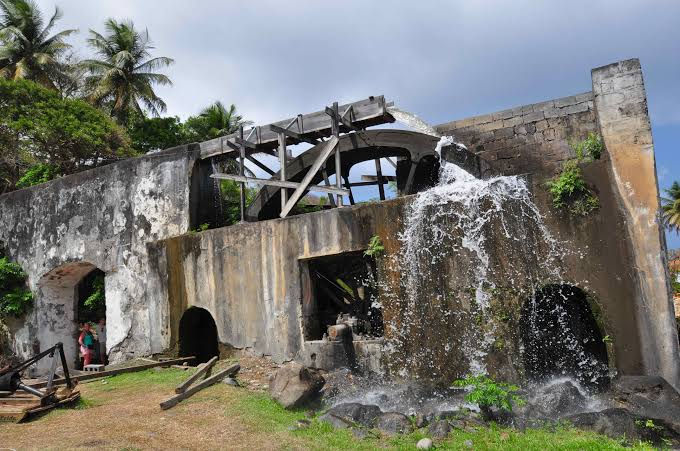
Grenada’s River Antoine estate has been crushing its cane with a water wheel since 1785, making it the oldest functioning water-powered distillery in the Caribbean. It only sells unaged rum, at a gentle 69% and 75% ABV. St Lucia and Antigua, and the Spanish-speaking mainland producers of Venezuela (whose DOC requires at least two years in oak) and Panama, all add further shades to the picture.
So What Makes Caribbean Rum Different?
Rum is made everywhere from Mauritius to Japan and from Queensland to Scotland these days, so what actually sets Caribbean rum apart?
Heritage. This is where rum was born, and some islands have been distilling it continuously for well over 300 years. That shows in the diversity: few spirit regions in the world have pot stills, Coffey stills, creole columns, multi-column stills and wooden stills all working within a few days’ sail of each other.
Tropical ageing. In the heat and humidity of the Caribbean, casks lose somewhere around 6–10% of their contents every year to evaporation, compared with roughly 2% in Scotland. Some islanders blame the duppies, mischievous spirits who supposedly help themselves to the rum (Frankly, we can’t blame the duppies). The upside is a much faster interaction between spirit and wood, so a five-year-old Caribbean rum can show far more oak and concentration than its age statement suggests. That is also why age statements from different climates are not directly comparable, and why the question of where a rum is aged is so hotly contested in Barbados and Jamaica.

Fermentation culture. Long, wild or dunder-boosted fermentations, particularly in Jamaica and Haiti, produce ester and flavour levels you will rarely find anywhere else.
Rules, actually. “Rum has no rules” is a popular line, but the Caribbean has a growing list of geographical indications, from Jamaica, Cuba and Martinique to Guadeloupe, Saint Lucia, Guyana and Venezuela. Several of them ban additives outright, which is stricter than the EU’s general rum definition (up to 20 g/L of sweetening permitted) and quite different from our own Australian approach, where the defining rule is a two-year minimum ageing period.
Compared with the rest of the world. Australian rum, as we have written before, is predominantly molasses-based, aged for at least two years and sits closest to the heavy Demerara and naval styles. Much of Asia’s enormous rum output, led by the Philippines, the world’s largest rum-producing nation, is lighter and column-distilled, while some Central and South American producers favour solera-style blends that tend towards the sweeter side. The Caribbean, however, covers the entire spectrum in one sea, from the lightest Cuban ron to the funkiest Jamaican pot still rum.
The Gargano Twist
There is one more thing worth knowing. Plenty of rum experts now argue that sorting rum by colour, or even by colonial heritage, tells you very little about what is actually in the glass. The best-known alternative is the Gargano Classification, devised by Luca Gargano of Italian bottler Velier together with Richard Seale of Foursquare in Barbados. Modelled on Scotch whisky, it sorts rum by how it is made:
• Pure Single Rum: pot still only, from a single distillery
• Single Blended Rum: a blend of pot and column still rum from a single distillery
• Traditional Rum: made on a traditional single or double column (Coffey) still
• Rum, or Modern Rum: made on modern multi-column stills
So everything you just told us about English, Spanish and French styles is rubbish?
Not at all, but here is the delicious irony: by his own account, it was Luca Gargano himself who came up with the English, Spanish and French colonial classification back in 1993, and he now says it isn’t the right one. Both systems are useful. The colonial one tells you where a rum’s traditions come from; the Gargano one tells you how it was actually made.
Thirsty Yet?
If you want to taste your way around the region, make a classic Daiquiri with a Cuban or Puerto Rican white rum; build a Rum Punch the Bajan way (“one of sour, two of sweet, three of strong, four of weak”); or mix a Jamaican pot still rum with a Demerara for a Mai Tai that will knock your thongs off. And when the arvo is long and hot, a Corn ’n’ Oil (aged Barbados rum, falernum and a dash of bitters) will do the trick nicely.

We can source a wide range of Caribbean rums in bulk, from light, column-distilled Spanish-style rums to full-bodied pot still styles. Just reach out to us and let us do the rest for you!


Comments